If college isn’t the right fit, there are excellent ways to start a career without it. The trades, the military, self-directed learning and career launch programs can all lead to good jobs, and a strong network and a portfolio of work count for more than a diploma in many fields. In this webinar recording, Praxis enrollment advisor Joshua Sternberg walks through each option, and two Praxis alumni share how Praxis shaped the work they do today.
Jump to a part of the video
When Joshua Sternberg was 16, his high school principal sat him down to talk about what came next. The advice covered college, the trades, and a pamphlet for the Marine Corps. That was the whole list. Josh didn’t know what he’d study in college and didn’t want to spend the money finding out, so he went looking for something else. At 17, he joined Praxis while finishing his senior year, and spent several years in a great sales job that came out of his time in the program. Today he’s an enrollment advisor at Praxis, talking with families every week about the same question he had.
He built this webinar for parents and young adults asking what other options are out there. Here are the main points, with Josh’s own words, and stories directly from two alumni who took a different route.
Wondering whether Praxis may be a good fit?
Leave your name and email in the form at the end of this post, and we’ll reach out with more information.
Is college the right call?
If you watch the recording, you’ll notice that was Josh was clear from the start: skipping college isn’t right for everyone. Doctors and lawyers need degrees, and so do plenty of other careers. His point was that the decision deserves the same scrutiny as any other big purchase.
The average federal student loan borrower owes about $40,000.1 Among recent graduates, about 42% work in jobs that don’t need a degree, which economists call underemployment.2
That number changes a lot depending on the major, and Josh’s most useful tip was to check the major before choosing the school. The New York Fed publishes underemployment rates by major. For recent nursing graduates it’s about 13%, and for elementary education and chemical engineering it’s under 20%. For criminal justice it’s about 66%, for performing arts 64% and for liberal arts 55%.2
How to build a network without college
One reason some people may push for college is the network. Josh split networks into two different types.
- A horizontal network is people at your own level: classmates the same age, with the same experience, competing for the same jobs.
- A vertical network is people further along in their careers, who can teach you, vouch for you and point you toward openings.
College is mostly the first kind.
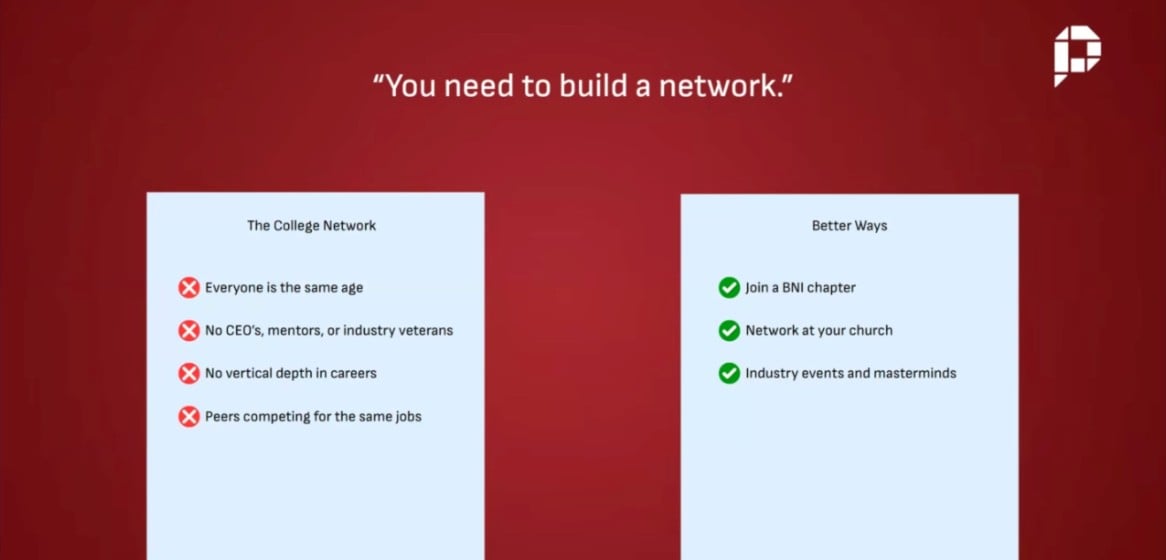
He suggested three places to build a vertical network, at any age, whether or not you go to college:
- A BNI chapter, where local professionals from different fields, such as an accountant, a real estate agent and a lawyer, meet regularly to trade referrals. Membership costs money, but far less than college tuition.
- Your church, which is free and puts you in a room with people of every age, income and line of work.
- Industry events and masterminds. Tag along with a parent, spouse or friend to their professional events and you’ll meet people doing interesting work in your own community.
The habit that matters most is building relationships before you need them, so people know your work by the time you’re looking for a job.
Four options after high school
Josh’s list of alternatives is broader than the one his high school principal gave him.
The trades
Electricians, plumbers, welders and other skilled trades are in demand. Training is usually shorter than a degree, and much of it is paid, through apprenticeships that let you earn while you learn. Josh called the trades “a good option, not the only option,” and a strong one for people who like hands-on work or working outside.
The military
The military teaches skills that carry over into civilian careers, such as heavy equipment and electrical work. Josh also pointed to the structure and maturity it builds, and to the education benefits, which can help pay for college later if that becomes the plan.
Self-directed learning
Online courses and certifications let someone learn a specific skill quickly and cheaply, on their own schedule. Google’s career certificates were Josh’s example. The key is turning what you learn into work other people can see. Our primer on self-directed learning covers how to do it well.
Career launch programs
These programs focus on getting a young person into their first good job or business quickly, with training, mentorship and support along the way. Praxis is one of them, and more on how it works is below.
How to stand out without a degree
Whatever route someone picks, they need a way to show employers what they can do. Josh’s answer was what he called the new signal.
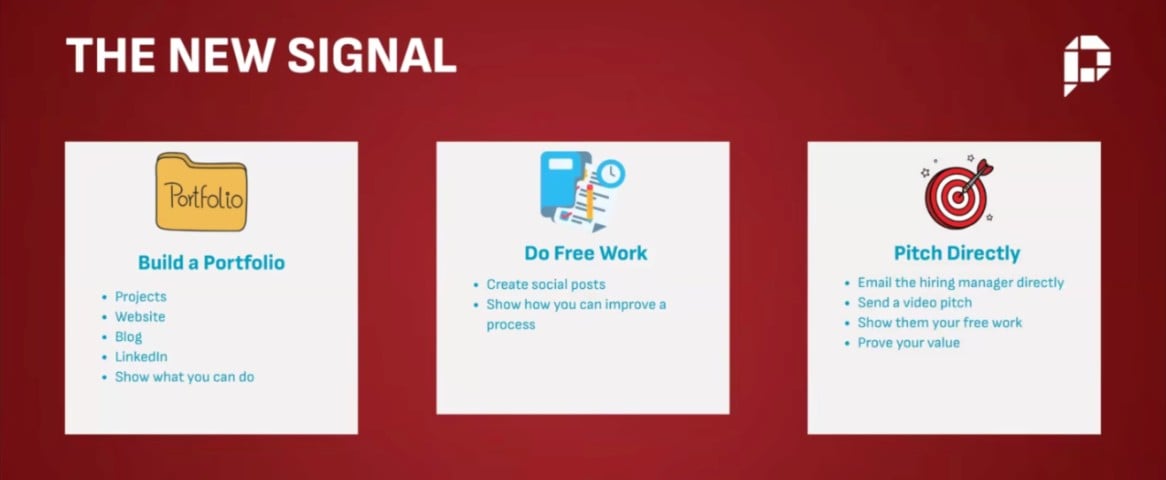
- Build a portfolio of projects, a simple website, blog posts about what you’re learning, and a LinkedIn profile that shows your work.
- Do a small piece of free work. If a company’s Instagram looks thin, make three posts for them and show them what you’d do.
- Pitch the hiring manager directly with that work, by email or a short video, instead of sending the same resume to a hundred openings.
When you want an opportunity, don’t pick up a handful of darts and throw it at the dart board.
Joshua Sternberg
Connor Boyack goes deeper on this in another Praxis webinar, Ditch the Degree, with six specific ways to stand out.
Two alumni, two paths
Josh then invited two Praxis alumni to speak:
MacKenzie: a full-time job and room to grow
MacKenzie finished Praxis in May 2026 and has since moved into a full-time job. What she valued most was learning to choose a job that moves her toward the next step, rather than holding out for a perfect first role. She still talks with her Praxis mentor when she has a decision to make.
You do not have to have your entire career figured out when you’re 18 years old or 20 or 22 or even 26. You don’t have to land your dream job immediately.
MacKenzie, Praxis alum
She also talked about what it’s like to take a different path when most of your friends are in college. The Praxis community, she said, “reminds me so much that I’m not doing something wrong just because I was doing something different.”
Katja: from a first job to her own freelance business
Katja joined Praxis right after high school, back in 2021. She’d been freelancing for years without knowing the word for it, and she wanted to prove what she could do rather than collect a diploma. In the program she learned to build a portfolio in small pieces and landed a job with a property management company.
She kept building her freelance work on the side. Through friends and mentors in the Praxis community, she was introduced to people who needed a ghostwriter. Five years after graduating, she has run her own freelance ghostwriting business for more than three years, works remotely, and spends half the year in Europe.
Most of my clients come in some way from my connections that I made within Praxis, directly or indirectly.
Katja, Praxis alum
Where Praxis fits
Praxis is a fully online career program for ambitious young adults, most of them 17 to 25. As Baley, a Praxis program lead, put it in the webinar, “You don’t need a plan before you join Incubate.” Working out a direction is part of what the program is for.
It starts with Incubate, six weeks that build the habits, mindset and foundational skills for what comes next. From there, participants earn their place in Accelerate, about six months of hands-on work with a 1:1 mentor and their cohort. They choose one of two tracks. Both begin with nine weeks of Business Foundations, hands-on projects in marketing, sales and operations, and then split.
The Career Launch Track
For young adults who want to start a career. It leads into a supported job search with warm introductions to employers in the Praxis partner network, for entry-level roles in sales, marketing, customer success and operations. It comes with a $45,000 job offer guarantee within 12 months of starting Accelerate.
The Entrepreneur Track
For young adults who want to start a business. Participants bring their own business idea or pick a starting point from the Praxis idea catalog. Over the 15 weeks after Business Foundations, they take one venture from idea to launch, with a mentor beside them. They interview potential customers to find out if the idea is something people would pay for, build a working first version, and get it in front of buyers with a live sales campaign they improve as they learn what works.
Questions parents asked about Praxis
What age is Praxis for?
Young adults, most of them 17 to 25. Seventeen is the usual minimum. Older applicants are welcome too.
What kinds of companies and careers does it lead to?
The Career Launch Track prepares participants for entry-level roles in sales, marketing, customer success and operations, with warm introductions to employers in the Praxis partner network. The Entrepreneur Track is for starting a business.
Is Praxis accredited? Can we use a 529 plan?
No. Praxis isn’t a college and doesn’t try to be. It’s a private career training program, so 529 plans, FAFSA and federal financial aid don’t apply.
Can we pay in installments?
Incubate is $850. Accelerate is $6,650 paid in full, or $7,500 on a two-payment plan.
What if Praxis turns out not to be a good fit?
Incubate is the place to find out. It’s six weeks, and a full refund is available within 7 days of the start date. Accelerate is earned through Incubate, so nobody commits to the full program up front.
About Joshua Sternberg

Joshua Sternberg is an enrollment advisor at Praxis and a 2021 Praxis alum. He joined Praxis at 17 while finishing high school, and now helps families work out what comes after it. Book a time to talk with an advisor.
Want more details?
Tell us a little about yourself and we’ll email you more information about Praxis.