You don’t need a four-year degree to start a good career. You do need a way to show an employer what you can do and convince them of your value. In this webinar recording, Connor Boyack, author of Skip College, explains why a degree no longer sets a young person apart and what employers look for instead.
Jump to a part of the video
Connor Boyack went to college because that’s what he was told to do. He calls it one of the biggest wastes of time and money in his life. Today he is president of Libertas Network, the nonprofit Praxis belongs to, and he spends a good part of his time talking with parents who are starting to suspect the same thing about their own kids’ plans.
This webinar was his case for a different route. If you’d rather read than watch, here are the main points, in Connor’s words where we can.
Three things we’re told about college
Most of us heard the same message growing up: go to college, because you’ll need the degree to get a job. Connor opened the webinar by asking the parents in the audience why they went. Most of them gave that answer.
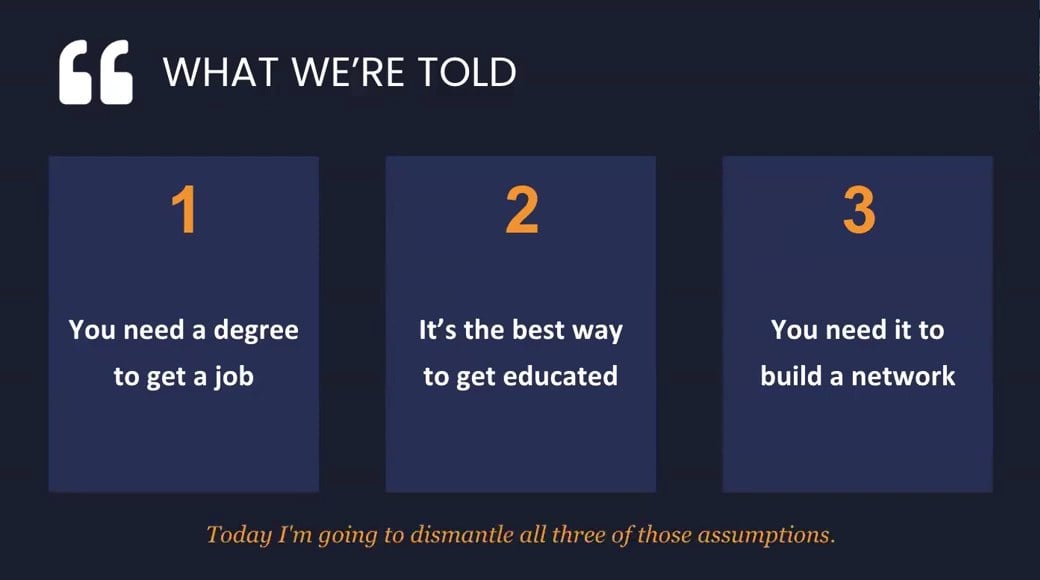
He took on each of the three in turn.
“You need a degree to get a job”
For a lot of entry-level work, that stopped being true a while ago. On Indeed, 51% of job postings don’t ask for any formal education, and only about 1 in 5 requires a bachelor’s degree.1 IBM removed the four-year degree requirement from more than half its U.S. openings, and by 2023 almost 20% of its U.S. hires were joining without one.2 Since 2021, 32 states have acted to remove degree requirements from state jobs.3
Employers are moving on from a college degree requirement. It is the education establishment that has not gotten the memo.
Connor Boyack
Meanwhile the degree itself has gotten less reliable as a ticket. Only about half of new bachelor’s graduates are working in a job that needs their degree a year after graduating.4
“College is the best way to get educated”
Connor’s point here is about speed. LinkedIn expects 70% of the skills used in most jobs to change by 2030.5 A four-year program that updates its curriculum every few years can’t keep up with that, and most of the teaching comes from people who study a field rather than work in it. As he put it, students are “hearing from professors who profess, but not practitioners who do.”
Employers have noticed. Back in 2013, Google’s head of people operations, Laszlo Bock, told the New York Times that GPAs and test scores were “worthless as a criteria for hiring,” apart from a slight link for brand-new graduates.6
“College is where you build your network”
A college network, Connor argued, is mostly horizontal: classmates your own age, with the same lack of experience, applying for the same jobs. Careers move through vertical relationships, with people a few steps ahead of you who know where the openings are and can vouch for you.
A truly valuable network has vertical depth. You need people 5, 10, 20 years ahead of you who can open doors.
Connor Boyack
You build those relationships by working alongside people, and a classroom full of peers can’t give you that.
Why a degree doesn’t set you apart anymore
In 1960, fewer than 1 in 10 American adults had a bachelor’s degree. Today it’s nearly 4 in 10, according to the U.S. Census Bureau, and most young people are steered toward one by default. Connor calls this signal vs. noise. When few people had a degree, it told an employer something about you. When everyone has one, it tells them very little.
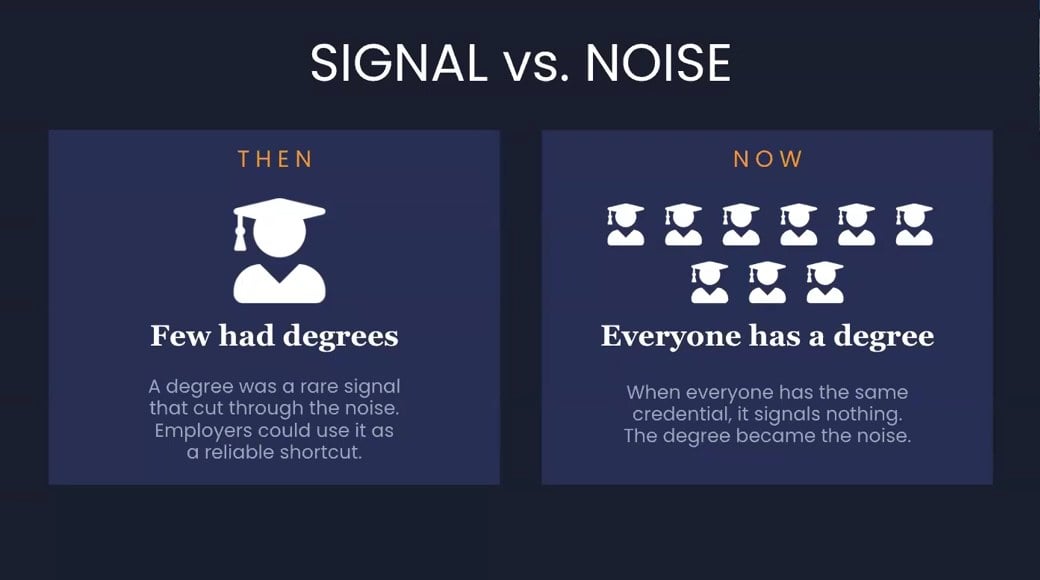
When everyone has the same credential, it doesn’t mean anything.
Connor Boyack
Connor hires for his own organizations, and he described what that looks like from the other side of the desk: a stack of 83 resumes with the same degrees and similar GPAs, and no way to tell who can do the work. The candidates who get noticed are the ones who show it.
How to stand out to employers without a degree
The most practical part of the webinar was Connor’s list of what works in place of a diploma. None of it needs anyone’s permission, and most of it costs little or nothing.
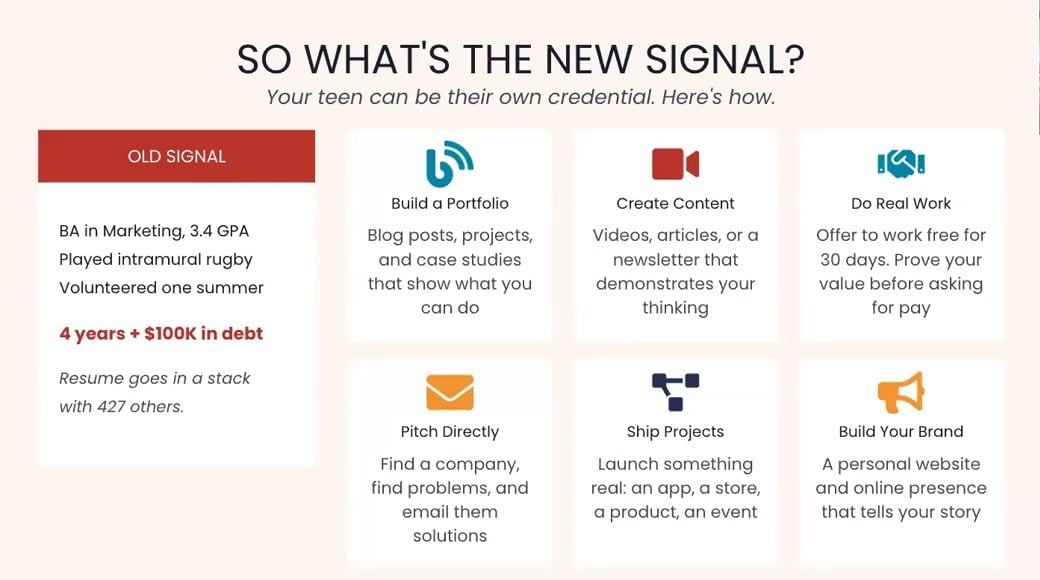
- Build a portfolio of blog posts, projects and short case studies that show what you can do.
- Create content, such as a newsletter, articles or videos, that shows how you think about a field you want to work in.
- Do the work before you’re hired. Pick a company you admire, find something you could improve, and do it. Connor suggested offering a month of work to prove your value before asking to be paid.
- Pitch a company directly. Instead of joining the stack of applications, email them about a specific problem you noticed and how you’d fix it.
- Launch something of your own: a small store, an app, a product or an event, however small.
- Build your own brand. Buy the domain for your own name and put your work there, so anyone who searches your name finds it.
His advice to the young adults listening was to start before they feel ready, with something small. That holds whether the goal is a first job or a business.
You want to be the signal. You don’t want to be trapped in the noise.
Connor Boyack
Try this week: pick one company you’d like to work for, spend an hour finding one thing you could help them with, and write it up as a one-page idea. Even if you never send it, you’ll have the first piece of a portfolio.
One Praxis alum’s path
Connor closed the main part of the talk with the story of Jed Mahrle, who joined Praxis at 17 with no degree and no work experience. Jed was hired as a lead development rep at PandaDoc, was promoted to lead a sales team, and later launched his own sales company.
It gave me everything I needed to stand out in a crowded job market: from real-world skills to the confidence to make an immediate impact. If you’re ambitious and willing to put in the work, there’s no better way to launch your career.
Jed Mahrle, Praxis alum
Where Praxis fits
Praxis is a fully online career program for ambitious young adults, most of them 17 to 25. It puts the ideas in this webinar into practice, with work participants can show an employer and mentors a few steps ahead of them.
It starts with Incubate, six weeks that build the habits, mindset and foundational skills for what comes next. From there, participants earn their place in Accelerate, about six months of hands-on work with a 1:1 mentor and their cohort. They choose one of two tracks. Both begin with nine weeks of Business Foundations, hands-on projects in marketing, sales and operations, and then split.
The Career Launch Track
For young adults who want to start a career. It leads into a supported job search with warm introductions to employers in the Praxis partner network, for entry-level roles in sales, marketing, customer success and operations. It comes with a $45,000 job offer guarantee within 12 months of starting Accelerate.
The Entrepreneur Track
For young adults who want to start a business. Participants bring their own business idea or pick a starting point from the Praxis idea catalog. Over the 15 weeks after Business Foundations, they take one venture from idea to launch, with a mentor beside them. They interview potential customers to find out if the idea is something people would pay for, build a working first version, and get it in front of buyers with a live sales campaign they improve as they learn what works.
Several of Connor’s new signals are the weekly work on this track. Participants publish a build log about their venture every week, make direct asks of strangers who have the problem they’re solving, and pitch their venture three times, ending with a final pitch to peers, mentors and the Praxis network.
Questions parents asked about Praxis
Who is Praxis for?
Young adults, most of them 17 to 25. Many are recent high school graduates, and some have left college. Older applicants are welcome too.
Is Praxis accredited? Can we use a 529 or financial aid?
No. Praxis isn’t a college and doesn’t try to be. It’s a private career training program, so 529 plans, FAFSA and federal financial aid don’t apply.
What kinds of careers does it lead to?
The Career Launch Track prepares participants for entry-level roles in sales, marketing, customer success and operations. The Entrepreneur Track is for young adults who want to start a business: every participant who does the work launches one and runs a live sales campaign. Praxis isn’t a path into trades, law or medicine.
Does my child need a business idea for the Entrepreneur Track?
No. Participants can bring their own idea or pick a starting point from the Praxis idea catalog. Everyone spends the first two weeks of the venture work defining it before committing to one.
Does my child need experience first?
No. There are no prerequisites, no GPA minimum, and nobody looks at a transcript. What matters is taking initiative, following through and being open to feedback. Incubate is where that shows.
How does the job offer guarantee work?
It applies to the Career Launch Track only. The Entrepreneur Track has no guarantee and ends with the participant pitching their venture. On the Career Launch Track, participants who meet the participation, performance and eligibility requirements are guaranteed one job offer within 12 months of starting Accelerate, with potential to earn at least $45,000 in the first year.
Will my child have to move?
Only to keep the guarantee. It requires being open to relocating anywhere in the U.S. A participant who doesn’t want to move can waive the guarantee and still get the full program, including coaching, mentorship and job search support.
What does it cost?
Incubate is $850. Accelerate is $6,650 paid in full, or $7,500 on a two-payment plan, and costs the same on either track.
About Connor Boyack

Connor Boyack is president of Libertas Network, the nonprofit Praxis belongs to. He wrote Skip College: Launch Your Career Without Debt, Distractions, or a Degree, a book for young adults and their parents about the paths to a good career that don’t run through a four-year degree.
Want more details?
Tell us a little about yourself and we’ll email you more information on Incubate and Accelerate.