As I’m writing this, over 120,000 schools are closed across the United States due to COVID-19 – forcing well over 50 million students, teachers, and parents to figure out what to do next (and fast).
If you’re like me, then you’re searching for a silver lining. Maybe you’re asking yourself questions like:
- What can I do if my [school / college / job] doesn’t reopen soon?
- How can I make the most valuable use of my time?
- What can I do now so I don’t fall behind learning?
- If I wanted to start learning/teaching online, where would I even start?
As difficult as this situation is, thanks to technology, there’s never been a better time in history to ask questions like these.
Since 2014, our team at Praxis has been conducting online learning with hundreds of participants each year – through a fully-remote program designed to teach people the skills they need to get hired and succeed in their careers.
We’ve gained a wealth of knowledge and insights about curating content, creating curriculum, and conducting learning online. From hosting live workshops and guiding participants through weekly curriculum checkpoints to facilitating one-on-one and group coaching sessions, and much, much more…
And because we know many people all over the country right now are faced with the difficult task of figuring some of this stuff out for the very first time, we want to share what we’ve learned with you.
Which is why we’ve created this short beginner’s guide to self-directed remote learning, in hopes of making your transition to online learning and personal development a little bit easier.
Enjoy
The Praxis Team
The Beginner’s Guide: Online Learning & Self-Directed Education in 2020
- An Introduction To Online Learning
- How To Get Started with Online Learning
- Self-Directed Learning: Creating Your Own Curriculum
- The Personal Development Project
- Building Community Around Content & Curriculum
- The Best Tools For Online Learning
- Additional Resources & Online Learning Platforms
- What’s Next?
- STUDENT BONUS: Creating Your First Personal Development Project
- TEACHER BONUS: How To Transition Your Curriculum Online
So…what’s all the fuss about online learning, anyway?
If I asked you to describe a learning environment, what image pops into your head?
If you’re anything like me, the interior of your old high school or college might come to mind. (I picture shelves of dusty old textbooks, chalkboards, rows of desks under fluorescent lights, and a teacher at the front of a classroom, towering over a bunch of students.)
While the majority of U.S. students still experience traditional classroom settings during the course of their education, a variety of non-traditional options for learning beyond the classroom already exist…and those options are evolving fast.
Over the past decade, online learning has made giant leaps. And I don’t just mean that some colleges have created online programs (Sorry, University of Phoenix).
Today, there are countless online options across the full spectrum of education, ranging from early childhood development and elementary schools to high schools, colleges, vocational programs, bootcamps, professional development, and beyond.
No matter what stage you’re at in your education (or career) and no matter what you want to learn, there are more options than ever to choose from. And not only are there a variety of options, but most online learning options today are both affordable and fully-remote.
If you’re serious about online learning, the real question is where should you start.
How can I get started with online learning?
In the early 2000s, a company called StumbleUpon made its debut. The site presented different website and advertisement recommendations to users, which were personalized to their interests and friends’ interests. Basically you could click a button to “stumble upon” new ideas, websites, videos, and more.
In the non-digital world, education traditionally takes on a somewhat formal shape. Curriculum is outlined, categorized by subject matter, and often apportioned across a timeline. Each subject contains milestones with individual lessons branching out to tie main themes together. Learning paths usually follow a somewhat linear progression.
But in a world where education can be administered digitally, there are untapped possibilities for creating a learning experience that looks a lot more like “stumble upon” than strict adherence to a rigorous curriculum.
Where non-digital learning is limited by the knowledge contained within the walls of a classroom (contained within a teacher’s mind or within a textbook), the digital world offers a virtually limitless pool of ideas, resources, and topics.
Much like a new user signing up for StumbleUpon, the best place to get started with online learning is to select your interests. Open a browser and begin by answering a single question – What would you like to learn today?
Within microseconds, search engines can serve up a wealth of results for whatever question you ask or whatever subject you’re interested in pursuing. With the sheer volume of results, any individual can quickly create his or her own bank of curriculum on any topic.
Of course, if you’re interested in following a rubric, there are a plethora of options for you to explore, too. Countless online learning platforms (more on these later) powered by millions of course creators the whole world over offer a limitless wealth of information and knowledge waiting to be accessed by anyone with a WiFi connection.
So, where would you like to start?
Should I create my own curriculum or complete existing courses?
With the internet, learning is not mutually exclusive. By choosing to study one subject, you don’t forfeit the chance to enroll in another. You can always pursue one thing and return to another later. That’s the real beauty of digital learning – it’s asynchronous, meaning content is available on your time and on your terms.
First things first, we’ve found online and self-directed learning to be more effective when you begin with a goal in mind. Your learning goals can (and should) be entirely personal – whether they’re related to your broader life and career goals or not. Those goals could be as small as exploring a new interest or as big as earning a promotion at work.
Whatever the case, here’s a short exercise as it relates to setting goals for your self-directed online learning experience:
- What do I want to learn?
- Why? What is my end goal? (Do I want to be able to complete a new task? Gain a new skill? Understand how something works?)
- What information do I need that I don’t have in order to obtain my goal(s)?
- What’s the best way to get it?
The good thing is, whatever you’re interested in, chances are you’re not the first person to ever have that goal. Which is why the above exercise is useful. Because the more clarity you have about what you’d like to accomplish, the easier it will be for you to seek out the appropriate content, curriculum, or resources to help you achieve your learning goals.
Still, if this is your first rodeo using the internet to “learn” versus just browse, here are some additional pointers to help guide your efforts:

Start narrow and expand broadly:
Search engines operate by gauging a thing called search intent. Engines return results based on an algorithmic best estimate of what it is you (the person typing) are searching for. The broader your search terms, the more likely your search results will be skewed.
Take for example Math as a search term versus Algebraic Expressions. Notice how the search for math returns a wide range of different results – everything from kids math courses to advanced math. Contrast that to results for algebraic expressions – where pages of results all relate closely to the search term.
An approach we’ve found to be useful when searching out information or resources online is to start narrow, then expand broadly. In other words, try to define as clearly as possible what subject or topic you’re searching for. Then, as you examine your results, expand to more broad language.
For example: Algebraic Expressions > Algebraic Formulas > Algebra > and so on.
Leverage page rank and reviews:
If you’re starting your online learning journey with a search engine, it might be useful to understand why results appear in the order they do. In addition to matching results with search intent, search engines also use algorithms to assess a website’s credibility. Google calls this “PageRank.”
Basically, Google counts the number and quality of links from other websites to a specific page. The more “backlinks” to a specific website and the more credible the sites are that link to a page, the higher page rank it is assigned.
Which is just a fancy way of saying that the higher up a result appears, the more digital credibility the website has. (A web page’s authority does not necessarily correlate with accuracy.)
If instead, you’re interested in exploring existing courses from online learning platforms, this is where reviews come in handy. While not a perfect measure, the quality and quantity of reviews for a particular course or course creator act as a strong signal for the content of a course. In other words, typically the more positive reviews a course has, the better.
PRO TIP: It’s also useful to read reviews versus just relying on star ratings. Somethings the qualitative information can reveal useful breadcrumbs of insight about a particular course or course creator.

Follow your interests and don’t limit yourself:
Another useful benefit of learning online is that you’re not limited to the subject matter within a specific textbook. You’re free to pursue a topic in any manner you’d like.
One big difference to learning online, though, is that there’s less accountability. With an online course (or digital school program), there is no teacher standing over your shoulder checking up on your progress or assessing your comprehension of a subject. It’s up to you to self-direct your learning experience.
This offers the freedom to explore ideas and interests as deeply or broadly as you like. (At Praxis, we’ve found this to be an extremely effective method for learning and personal development.)
But be aware, most of the world still accepts traditional credentials – like grades, degrees, and certificates – as an indicator of understanding and mastery of a particular subject. Because self-directed learning (whether online or not) does not usually offer grades, if you want to convince someone that you’ve mastered something on your own, the burden of proof is on you.
In other words, if you want to pursue a self-directed learning experience, recognize that most people won’t “take your word for it” about what you’ve learned. You’ll also need to prove you learned it (read on for more on this in the next few sections).
Keep a content bank:
If you’ve spent even five minutes browsing anything, then you’ve experienced just how quickly you can amass an unmanageable collection of websites, resources, blog posts, videos, and more. Which is why we recommend creating your own content bank.
A content bank is exactly what it sounds like – a place to store all of the content you discover. This could be as simple as a note app with links to websites or as complex as a database with tags for specific subjects. Really, it’s up to you what you make of this. But a content bank is an excellent resource for keeping track of the content you’re consuming.
PS – there are already a ton of simple and easy-to-use free tools that make great content banks. Check out The Best Tools for Online Learning section of this post for more on these tools.

Document your progress:
As we mentioned earlier, with a self-directed learning experience, there’s no one standing over your shoulder checking up on your progress – just like there’s no grade to be had to indicate you’ve mastered a subject. Which is why it’s all the more imperative for you to take charge of your learning experience if you want to get the most out of it.
In addition to a content bank, developing a system for tracking your progress is another useful aspect of creating a self-directed learning experience. Fortunately, most of the same tools we’d recommend as a content bank also have features that make it easy to track, add notes, and schedule or assign tasks to yourself.
Again – the aim of tracking your progress is less about working for a grade and more about staying organized and managing your experience. This is not about completing assignments or busy work.
The usefulness of the things you learn is limited by your ability to transform it into proof of your comprehension. In other words, it’s not only up to you to prove you read some articles or watched some YouTube videos but also to show you understand the ideas.

Learn out loud:
While tracking the curriculum / content you explore and documenting your progress is useful, the real fun is in putting your learning on display (both for yourself and for others).
Whether you start your own blog, YouTube channel, podcast, or even something as simple as posting daily on social media about the topics you’re learning, creating a digital paper trail of your learning experience is a useful way of putting your progress on display. And it’s the first step in creating your own signal to others in lieu of a normal credential or grade.
The aim of learning out loud, though, is not just to convince others. It’s also a great way to invite feedback about your own ideas in the real world – and improve your learning.
When you learn out loud and regularly publish (whether it’s written content, video content, audio, or whatever), you invite criticism from others. Sure, not all of that criticism will be useful. But it’s a great and low-cost method for collecting feedback about the usefulness of the stuff you’re learning.
Not to mention, when you regularly create content – especially around a specific topic – you are effectively forging your own reputation as someone who is curious, capable of learning, and well-versed on those ideas. And those are extremely valuable signals when it comes to future job or career opportunities.
These are just some recommendations we’ve found to be useful for getting started with your own. But if you’re interested in going a level deeper with your own self-directed education experience, then read on. Next up, we’ll introduce you to Personal Development Projects (PDPs) – and how you can use them to level up any skill, land job opportunities, and much more.
 The Personal Development Project (PDP)
If all this seems like a lot of information for you to handle, don’t worry. There’s a simple system that can help you put all these aspects of personal education into practice. It’s known by the Praxis community as the Personal Development Project, or PDP.
“Creating and completing a PDP helps you instill creativity as an everyday habit, develop marketable skills, and provide tangible evidence that you can create value for others. It helps you overcome those unproductive habits you developed in over-structured institutions like school and start deciding for yourself what knowledge and skills you value. Ultimately, the purpose of a PDP is to become a superior version of yourself within a short-time frame.” — Praxis CEO Cameron Sorsby
What is a PDP?
A PDP is a month-long project built around a specific goal. It breaks down a big goal into tiny, bite-size pieces that are easy to complete. It allows you to document your progress while you’re learning. And most of all, it helps you keep accountable to your goals.
Getting Started with PDPs
Start by making a list of things you want to learn. Remember to start narrow!
And here’s a secret for putting that list together: ask questions. Like this:
- How can I become a better writer?
- Why do people love concerts?
- How do forex markets work?
- How can I find a job I love?
The first question can be put into a category of writing. The second question is a study of social interactions and the psychology of music. The third question has to do with economics.
But by asking these questions, you’re giving yourself a more specific starting point for your self-education journey. You’re also allowing yourself to follow your interests!
Make a list of 20 of these questions. You’ll pick one (or several that are related) for your PDP.
Build Your Outline
1. PDP Overview: What is the outcome you want to have by completing this project? Summarize your final goal and the value you’ll be creating through your project.
Outcomes related to the specific questions could be:
-
- I want to be a strong writer like David Perell.
- I want to gain a basic understanding of social theory.
- I want to come away knowing the basics of trading in forex markets
- I want to land a job with a company whose mission I love.
2. PDP Deliverable: State the specific things you’ll create through your project. This is the actual physical project related to the goal you set for yourself.
Here are some specific things you could create based on our four questions:
-
- A 10,000 word article published on a 3rd-party site
- A webinar on how music brings people together
- A beginner’s guide to forex based on your experience trading
- A podcast series discussing how to find a job you love
3. PDP Activities: What activities will you complete on a daily and weekly basis to reach your goal? Outline them.
Here’s what a sample outline could look like for your writing goal:
Week 1:
- Research top resources on writing well.
- Research a topic to write on.
Week 2:
- Continue studying writing tips and share your favorites to social media.
- Create an outline for your article.
Week 3:
- Complete 3 writing exercises suggested by great writers.
- Write the rough draft of your article.
Week 4:
- Research publications you’d like to send your article to.
- Edit and complete your article, and send it to several publications for consideration.
Here’s an example of a completed PDP outline. If you’ve followed the steps above, then all that’s left to do is complete your PDP!
PS – Want help crafting your own personal development project? Email us @ our contact form.
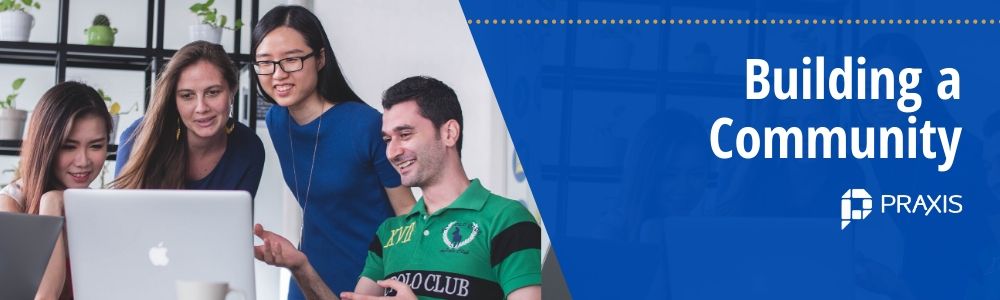
How to find an online learning community, make new friends, and learn with other people.
The social aspect can be a common hurdle with online versus in-person learning. When you’re in a classroom, face-to-face with peers, it’s easy to interact organically, ask questions in real-time, and feel like you’re less alone in your learning experience.
Still, technology has made giant leaps in helping people from all over the world connect with other people. Today, you can still get the benefit of social interaction remotely. But first, you will have to find your “tribe” online.
If this is your first time using the internet to seek out people interested in the same ideas, it can feel daunting. But don’t sweat it. Below, we’ve highlighted some of our favori

Praxis